

What Are Tea Polyphenols? A Beginner-Friendly Guide
Steep. Sip. Slip into your mood.
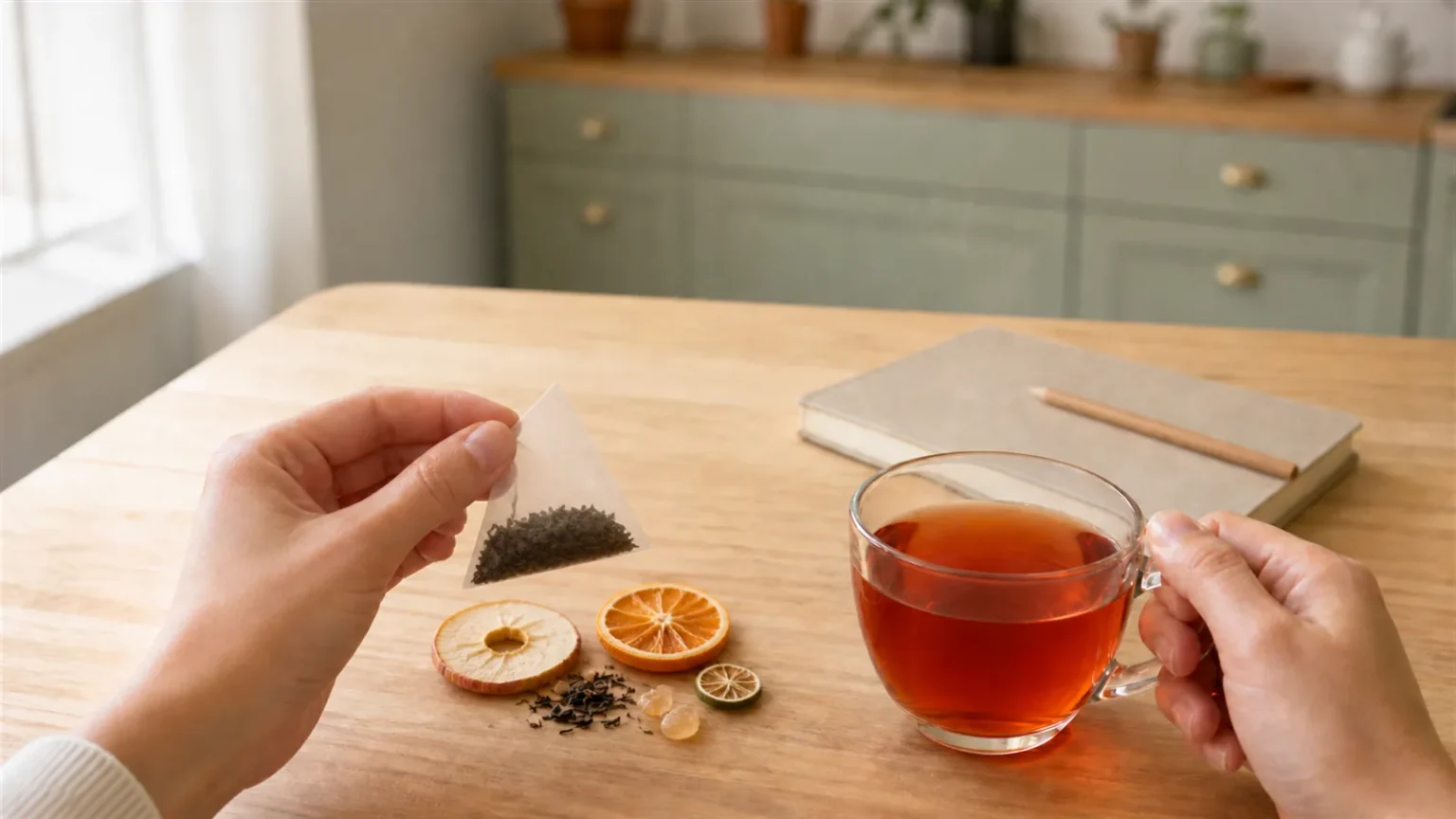
Tea polyphenols are a broad family of naturally occurring plant compounds found in Camellia sinensis leaves. They include catechins that are prominent in green tea and oxidation products such as theaflavins that help distinguish black tea. A brewed cup does not have one fixed polyphenol amount: the leaf, processing method, particle size, tea-to-water ratio, time, temperature, agitation, and other preparation details can all change what reaches the cup.
Fruit tea needs an ingredient-first interpretation. A fruit infusion without Camellia sinensis may contain polyphenols from fruit, flowers, herbs, or spices, but it should not automatically be described as having the same tea-polyphenol profile as green or black tea.
Tea Polyphenols: Key Facts
- Tea polyphenols are a group of compounds, not one single ingredient.
- Green, black, white, and oolong tea all begin with Camellia sinensis.
- Catechins are especially associated with green tea, while black-tea processing creates compounds including theaflavins.
- Fruit and herbal infusions can contain other plant polyphenols even when they contain no true tea.
- Brewing changes extraction, so one universal cup value should not be assumed.
- The presence of polyphenols is not proof that a drink prevents or treats a health condition.
What Are Tea Polyphenols?
Polyphenols are a large chemical family made by plants. In tea, the term covers several related groups rather than one molecule with one effect. These compounds help shape the leaf and the finished infusion, including aspects of color, bitterness, astringency, and mouthfeel.
Tea also contains many non-polyphenol components, including caffeine, amino acids, carbohydrates, aroma compounds, minerals, and other substances. Polyphenols and caffeine are therefore not interchangeable. A tea can contain both, and the amount of one does not tell you the exact amount of the other.
A Beginner’s Map of Tea Polyphenols
| Term | Plain-English meaning | Where it fits | Do not assume |
|---|---|---|---|
| Catechins | A group of flavan-3-ols that includes EGCG, EGC, ECG, and EC | Prominent in green tea and present in varying profiles across true teas | That every green tea or brewed cup contains the same amount |
| Theaflavins | Catechin-derived oxidation products formed during black-tea processing | Associated with black tea’s chemical and sensory profile | That black tea has “no polyphenols” because catechins changed |
| Thearubigins | A complex mixture of further oxidation products | Part of the color and character of black tea | That the term describes one fully characterized molecule |
| Flavonols and phenolic acids | Additional polyphenol families found in tea and many other plants | They add to the broader chemical profile | That catechins are the only relevant polyphenols |
| Tannins | A term often used loosely for astringent polyphenolic compounds | Useful in everyday taste discussions when defined carefully | That “tannins” and “all tea polyphenols” are exact synonyms |
Green Tea vs Black Tea: Same Plant, Different Profile
Green tea and black tea are not made from unrelated plants. Both come from Camellia sinensis, but the leaves are processed differently. Green-tea processing limits oxidation early, so its profile retains more of the original leaf catechins. During black-tea manufacture, leaf disruption and controlled oxidation transform part of the catechin profile into theaflavins, thearubigins, and other products.
This does not support the shortcut that green tea “has polyphenols” while black tea does not. Both contain polyphenols; the types and proportions differ. It also does not justify declaring one tea universally better. Cultivar, growing environment, grade, manufacture, storage, and brewing can all change the final composition.
For a wider ingredient, caffeine, flavor, and brewing comparison, read Fruit Tea vs Green Tea vs Black Tea.
Does Fruit Tea Contain Tea Polyphenols?
The answer depends on the tea base.
- Fruit-flavored green or black tea: contains Camellia sinensis, so it contains tea-derived polyphenols.
- Fruit-and-herbal infusion without true tea: may contain polyphenols from fruit, flowers, herbs, or spices, but its profile is not automatically the same as green or black tea.
- Mixed blend: may contain both true-tea polyphenols and compounds contributed by the other botanicals.
Research on commercial fruit infusions has identified phenolic compounds, but the measured profiles varied among products and preparation conditions. That is why “fruit tea” is not a laboratory specification. The complete ingredients and the tested product matter more than the flavor name.
If the label language feels unclear, use our guides to fruit tea vs fruit infusion and fruit tea ingredients.
What Changes Polyphenol Extraction in the Cup?
The dry leaf is only the starting point. Research comparing prepared green and black teas has found that product and preparation variables influence the polyphenols extracted into the beverage. Relevant variables include:
- tea variety, growing environment, and manufacturing method;
- leaf grade and particle size;
- whether the tea is loose or contained in a bag, plus the bag’s construction;
- the amount of tea and water;
- water temperature and infusion time;
- agitation during preparation.
A longer or hotter infusion can increase the extraction of some compounds in some products, but there is no universal formula that applies to every tea or fruit blend. More extraction can also change bitterness and astringency. Follow the product’s preparation directions instead of treating the longest or hottest brew as automatically superior.
Cold brewing does not remove the polyphenols already present in the ingredients, but it creates a different extraction environment. Without a product-specific test, Cozyslip should not publish a precise hot-versus-cold polyphenol comparison.
Why Do Polyphenols Affect Astringency?
Astringency is the drying, puckering, or rough sensation that can appear in tea. It is not exactly the same as bitterness. Studies of tea chemistry and sensory response show that multiple polyphenols can contribute to astringency, partly through interactions with proteins in saliva.
That relationship is more complex than “stronger astringency equals more polyphenols.” Different compounds can create different sensations, and brewing, concentration, temperature, sweetness, acidity, and other ingredients can change perception. Taste is not a reliable home test for a polyphenol amount.
Are Tea Polyphenols Proven Health Benefits?
Tea polyphenols are widely studied, including in laboratory, animal, observational, and clinical research. Those study types answer different questions. A compound showing antioxidant behavior in a laboratory test does not by itself prove that drinking a specific tea prevents or treats disease in people.
The National Center for Complementary and Integrative Health notes that human findings for many promoted tea benefits remain limited or inconclusive. It also separates tea consumed as a beverage from concentrated green-tea extracts. Extracts and supplements can deliver different exposures and have different safety and interaction concerns.
For Cozyslip, the responsible approach is simple: explain the ingredients and tea base, avoid disease claims, and do not publish a polyphenol number for a product without appropriate product-specific testing.
How to Read a Tea Label Without Overclaiming
- Identify the base. Look for green tea, black tea, white tea, oolong tea, matcha, or the botanical name Camellia sinensis.
- Separate the other plants. Fruit, flowers, herbs, and spices may add their own compounds, but they do not make every blend chemically equivalent.
- Check caffeine separately. Polyphenols are not caffeine. Use the complete formula to identify caffeine sources.
- Follow the stated preparation. Tea amount, water, time, and temperature influence the cup.
- Use tested numbers only. A category-level study cannot provide the value for an individual product.
For the caffeine step, see Does Fruit Tea Have Caffeine?
Tea Polyphenols FAQ
Are tea polyphenols the same as tannins?
Not exactly. Tannins are a group of polyphenolic compounds, but the word is often used loosely in tea discussions. It should not be treated as a precise synonym for every polyphenol found in tea.
Are catechins tea polyphenols?
Yes. Catechins are an important group of tea polyphenols. EGCG, EGC, ECG, and EC are commonly discussed examples, especially in green tea research.
Does black tea still contain polyphenols?
Yes. Black-tea processing changes the polyphenol profile rather than removing every polyphenol. Part of the catechin profile is transformed into theaflavins, thearubigins, and other oxidation products.
Does fruit tea contain tea polyphenols?
It depends on the base. A fruit blend containing green, black, white, or oolong tea has tea-derived polyphenols. A fruit-only or herbal infusion may contain other plant polyphenols but should not automatically be assigned the same profile.
Are tea polyphenols the same as caffeine?
No. Polyphenols and caffeine are different groups of compounds. True tea commonly contains both, but one does not provide a direct measurement of the other.
Does longer steeping always mean more tea polyphenols?
Infusion time can change extraction, but the result also depends on the product, particle size, tea-to-water ratio, temperature, agitation, and other factors. Longer is not automatically better; follow the preparation directions for the specific tea.
Sources and Research Notes
- National Center for Complementary and Integrative Health: Tea
- National Center for Complementary and Integrative Health: Green Tea
- NIH Office of Dietary Supplements: Tea and Tea Catechins
- Astill et al.: Product and Preparation Factors in Green and Black Tea Infusions
- Wang et al.: Polyphenol Oxidation During Black Tea Processing
- Zhuang et al.: Polyphenols and Green Tea Astringency
- Młynarczyk et al.: Phenolic Composition of Fruit Tea Infusions
This guide explains tea categories and research boundaries. It does not provide medical advice or laboratory values for individual Cozyslip products.