

Can You Boil Fruit Tea? Stovetop Simmering vs Steeping
Steep. Sip. Slip into your mood.
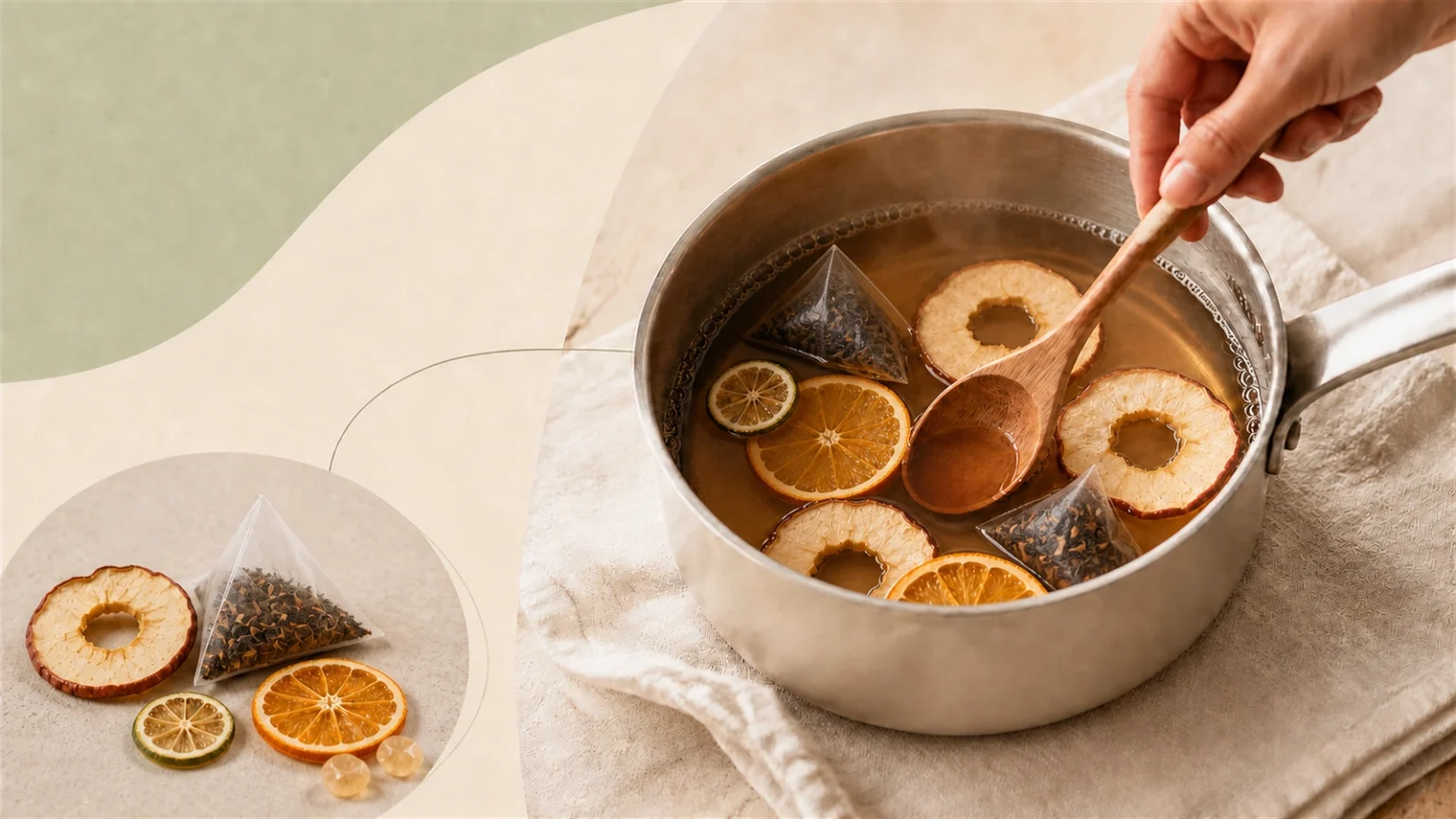
Can you boil fruit tea? Sometimes—but “boil” can describe several different things. You can gently simmer some fresh-fruit, dried-fruit, herb, or spice preparations when a reliable recipe calls for it. That does not mean every packaged fruit tea, herbal infusion, or tea bag should stay in a boiling pot.
Hot-water steeping, gentle stovetop simmering, and a rolling boil are different methods. The safest starting point is simple: identify the ingredients, read the package directions, and do not replace a product-specific method with a generic fruit-tea rule.
Can You Boil Fruit Tea? Key Facts
- Pouring freshly heated water over a blend is steeping, even if the water was boiling before you poured it.
- Keeping fruit, herbs, or spices over low heat is simmering.
- A rolling boil is more vigorous and is not the default method for packaged fruit tea.
- Fresh fruit, dried fruit, flowers, spices, and true tea leaves do not respond in exactly the same way.
- More extraction is not automatically better flavor—or better for every ingredient.
- For a commercial blend, the current package directions remain the source of truth.
Steeping, Simmering, and Boiling Are Not the Same
The words often overlap in casual conversation, which is why the question becomes confusing. A person may say “boil the tea” when they actually mean “boil water, turn off the heat, and steep the tea.” Another recipe may ask you to keep fruit and whole spices in a pot over gentle heat. A decoction may call for more sustained heating.
| Method | What happens | Common use | Main caution |
|---|---|---|---|
| Hot-water steep | Hot water is poured over the ingredients; the pot or cup is not kept over active heat. | Many packaged fruit, herbal, and true-tea blends. | Longer is not always better; follow the label. |
| Gentle simmer | The liquid remains over low heat with small, restrained bubbles. | Some fresh-fruit, dried-fruit, herb, or whole-spice preparations. | Fruit can soften, aroma can change, and tea leaves may become too strong. |
| Rolling boil | The liquid bubbles vigorously and continuously. | Only methods or decoctions that specifically call for it. | It can change texture, drive off aroma, and extract more than you intended. |
A USDA homemade fruit-and-herb tea example illustrates the distinction: its dried mixture is served by steeping it in hot water and then straining, not by keeping the blend at a rolling boil. One example does not set the rule for every tea, but it shows why “fruit tea” does not automatically mean “simmer it on the stove.”
Start With the Ingredients, Not the Flavor Name
“Fruit tea” is a broad market phrase. It can mean a fruit-and-botanical infusion, or it can mean black, green, white, or oolong tea blended with fruit. If those names feel unclear, begin with our guide to fruit tea, fruit infusion, and true tea.
Fresh or dried fruit and whole spices
These ingredients appear in many stovetop drinks. Gentle heat can soften fruit and draw flavor from firmer pieces or whole spices. Still, the ingredient list alone does not provide a safe universal simmer time. Use a tested culinary recipe, keep edible ingredients separate from packaging, and pay attention to whether the method calls for a simmer or an actual boil.
Flowers, peels, and delicate herbs
Hibiscus, rosehip, citrus peel, mint, and other botanicals can differ greatly in strength, acidity, aroma, and preparation. Some blends are designed for a straightforward hot-water steep. Sustained heat may change their aroma or make one ingredient dominate the cup. “Herbal” is not a promise that unlimited boiling is appropriate.
Black, green, white, or oolong tea
These are true teas from Camellia sinensis. They contain caffeine and have their own temperature and time considerations. If your fruit blend includes true tea, do not assume that a longer stovetop boil will improve it. First check whether the blend contains true tea, then use the preparation directions written for that formula.
Tea bags and individually packed servings
A tea bag may be designed for steeping in a cup rather than cooking in a saucepan. Remove any outer wrapper, paper tag, string, label, oxygen absorber, or other non-edible component. If the package does not clearly authorize stovetop heating, do not improvise. Open or transfer the edible ingredients only when the product directions allow it.
What Research Can—and Cannot—Tell Us
Brewing temperature and time do change what moves from plant material into water. A study of 16 commercial fruit teas found that hotter water extracted more measured phenolic compounds under its laboratory conditions. That finding does not prove that every fruit tea should be boiled, that the result tastes better, or that it produces a particular health outcome.
A 2026 study of Turkish mallow petal tea compared short hot, extended hot, and cold preparations. The methods produced different volatile, phenolic, organic-acid, and sensory profiles; the short hot preparation received stronger aroma and overall-liking scores than the extended hot preparation in that specific material. The lesson is not “use one method for all herbs.” It is that preparation changes both chemistry and the drinking experience.
Extraction can also include things you did not intend to increase. Research on teas and herbal infusions contaminated with tropane alkaloids found greater transfer during sustained near-boiling decoction than during a standard infusion. This does not mean ordinary tea is automatically unsafe. It does show why “more extraction” is not a universal quality goal.
For a broader explanation of compounds and claim limits, read our beginner’s guide to tea polyphenols. Laboratory measurements from one set of samples cannot establish the best method for every commercial blend.
A Six-Question Check Before You Heat the Pot
- What are you preparing? A fresh-fruit recipe, a dried botanical blend, or a packaged tea?
- Does it contain true tea? Look for black, green, white, oolong, or matcha.
- What does the instruction actually say? “Pour over,” “steep,” “simmer,” and “boil” are not interchangeable.
- Is every item food-safe under heat? Keep wrappers, tags, labels, absorbers, and non-edible packaging out of the pot.
- What is the intended result? A normal cup of tea and a stovetop fruit-and-spice preparation are different projects.
- Is the method credible? Prefer the current product label or a tested recipe over an unsourced social-media shortcut.
When Not to Improvise
Do not create a stovetop method for an unfamiliar botanical ingredient simply because it appears in something called tea. Extra caution is sensible during pregnancy, while taking medication, or when managing allergies or another health condition; use the product warning and qualified medical guidance rather than a general blog post.
Do not boil sealed retail packaging, a tagged tea bag, or any sachet unless the manufacturer explicitly says that the complete item is designed for that use. Do not assume that strong color means the drink is safer, healthier, or finished. Appearance is not a laboratory measurement.
Fresh-Fruit Tea Still Needs Food-Safety Basics
When fresh fruit is part of the preparation, begin with clean hands, clean utensils, safe drinking water, and washed produce. Serve the drink promptly or cool and refrigerate it rather than leaving it warm for an open-ended period.
The U.S. Food and Drug Administration advises refrigerating foods that require refrigeration within two hours—one hour when the air temperature is above 90°F—and keeping the refrigerator at or below 40°F / 4°C. Because recipes and ingredients differ, this article does not assign one refrigerated shelf life to every homemade fruit tea. See our guide to how to store dry blends and prepared fruit tea for the broader storage framework.
The Practical Answer
You can boil water for fruit tea, and you can gently simmer some fruit, herb, or spice preparations when a credible recipe tells you to. Those statements are not permission to boil every packaged blend.
Use this order: identify the ingredients, distinguish steeping from simmering, follow the product or recipe directions, and judge the finished cup by both safety and taste—not by the idea that hotter or longer must be better.
Can You Boil Fruit Tea? FAQ
Is boiling fruit tea the same as steeping it in boiling water?
No. If you heat the water, remove it from the heat, and pour it over the blend, you are steeping. If the ingredients remain in a pot over active heat, you are simmering or boiling them.
Can you boil a fruit tea bag?
Only if the current package directions explicitly call for stovetop heating. Many tea bags are designed for cup steeping. Keep tags, wrappers, labels, strings, and other non-edible components out of the pot.
Can you simmer fresh fruit with tea?
Some tested recipes combine fresh fruit, spices, herbs, or tea over gentle heat. Follow that recipe and pay attention to the tea base; prolonged heat may make true tea stronger or more bitter.
Does boiling make fruit tea healthier?
That conclusion is not supported as a universal rule. Hotter or longer preparation can increase extraction of some measured compounds, change flavor, reduce desirable aroma, or increase extraction of unwanted substances. Results are ingredient-specific.
Can black or green tea be simmered with fruit?
It can be part of a specific recipe, but it should not be the default assumption. Black and green tea contain caffeine and have their own time and temperature considerations. Follow the label or tested recipe.
What is a decoction?
A decoction is a preparation method that keeps plant material in heated water, often for firmer roots, bark, seeds, or other ingredients specified by the method. It is more intensive than pouring hot water over a typical tea blend and is not automatically appropriate for every botanical.
Sources and Research Notes
- USDA VegU: Homemade Fruit and Herb Tea
- FDA: Are You Storing Food Safely?
- Evaluation of Antioxidant Properties and Phenolic Composition of Fruit Tea Infusions
- Impact of Diverse Brewing Conditions on Turkish Mallow Petal Herbal Tea
- Effect of Brewing Time and Temperature on Tropane Alkaloids in Teas and Herbal Infusions
This educational guide explains preparation categories and research boundaries. It does not provide medical advice, a universal recipe, or stovetop directions for any individual Cozyslip product.