

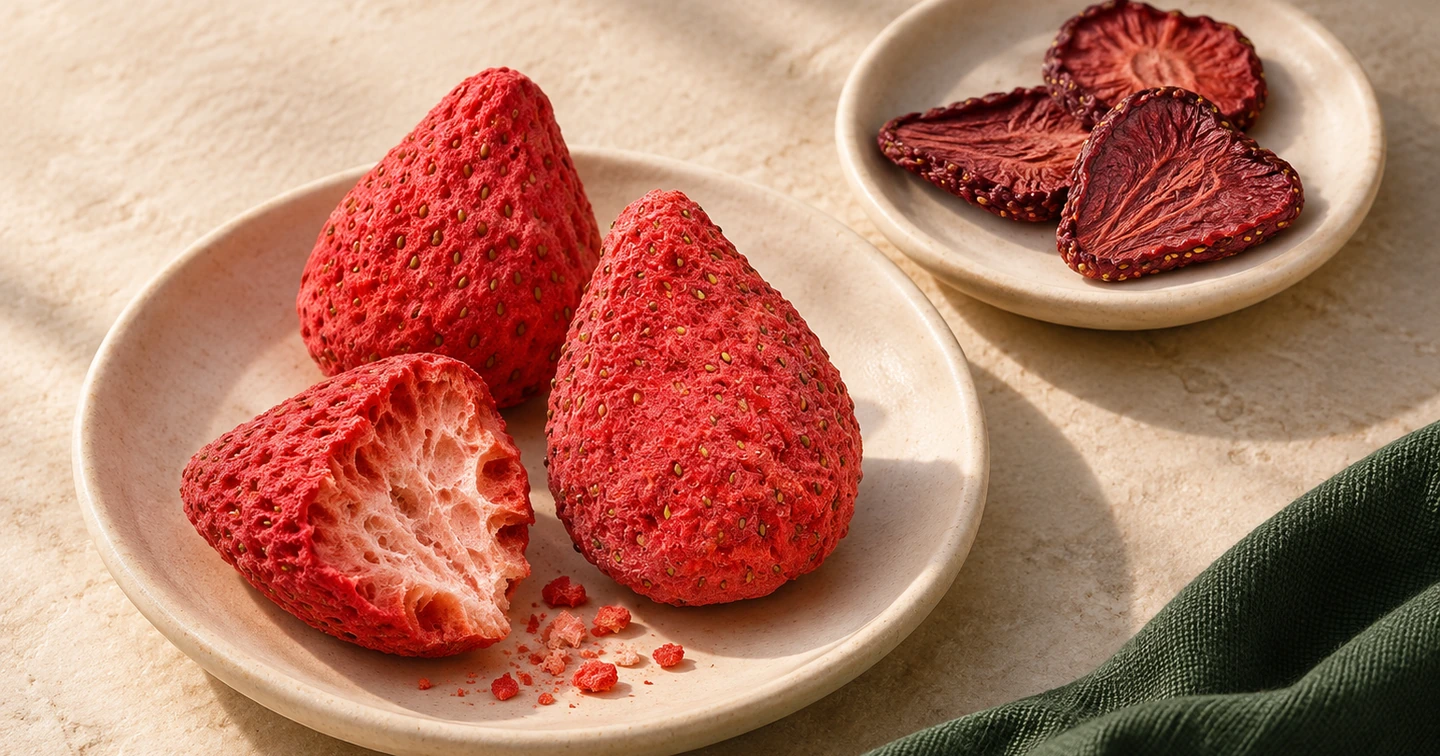
Freeze-dried vs dehydrated fruit is mainly a comparison of how water leaves the fruit. Freeze-drying removes ice from frozen fruit as vapor under vacuum. Conventional hot-air dehydration removes water by evaporation using heated air. Both produce dried fruit, but the route changes texture, appearance and how much of a particular compound survives processing.
Key Facts at a Glance
- Freeze-drying is a type of dehydration; here, “dehydrated” means conventionally hot-air-dried fruit.
- Freeze-dried fruit is typically porous and crisp; hot-air-dried fruit is often denser and chewier.
- Nutrient retention depends on the fruit, compound, pretreatment and drying conditions; low-temperature air-drying is a separate process from freeze-drying.
- Cozyslip uses a blend of freeze-dried and gently low-temperature-dried fruits.
- A dry product’s storage life does not establish how long its original vitamin content lasts.
- Measurements in dried fruit do not tell you the nutrient content of a strained fruit tea.
How Do the Drying Processes Differ?
In freeze-drying, fruit is frozen and placed under reduced pressure. Ice changes directly into water vapor, a process called sublimation. Controlled heat supplies energy for that change, so freeze-drying does not mean the equipment uses no heat. The process can leave a porous structure where ice used to be. Utah State University Extension explains the process.
A conventional dehydrator moves warm air around fruit so liquid water evaporates. Fruit can shrink as it dries. The outcome depends on the fruit, slice size, pretreatment and drying schedule; the word “dehydrated” does not describe one standardized recipe.
| Feature | Freeze-dried fruit | Hot-air-dried fruit |
|---|---|---|
| Water removal | Ice becomes vapor under vacuum. | Water evaporates into heated moving air. |
| Dry texture | Often light, porous and crisp; easily crushed. | Often compact and chewy; some products are crisp. |
| Flavor and color | Can preserve recognizable fruit aroma and color. | Can develop darker color and a different flavor profile. |
| After adding water | Pieces absorb water and soften; they do not necessarily dissolve. | Pieces also rehydrate, with a different final texture. |
| Production demands | Freezing, vacuum equipment and controlled drying add complexity. | Heated airflow generally requires simpler equipment. |
These are process tendencies, not a blind tasting or a guarantee about every package. Iowa State University Extension’s freeze-drying overview describes the equipment and storage considerations.
Where Does Gentle Low-Temperature Drying Fit?
Low-temperature hot-air drying removes water by evaporation, even at about 40°C. It can preserve some compounds, but “gentle” does not mean unchanged nutrition or freeze-dried retention levels. Temperature, time, airflow and oxygen exposure all matter. A lower temperature can mean a longer drying time, and different compounds respond differently. Tylewicz and colleagues discuss these trade-offs.
For example, a study of orange by-product found more measured vitamin C after drying at 40°C than at the hotter settings tested, but total phenolics were highest at 60°C under matched airflow. This was peel and processing residue, not ordinary fruit slices or Cozyslip ingredients, and it did not establish retention relative to fresh fruit. Razola-Díaz and colleagues.
Does Freeze-Drying Retain More Nutrients?
It can retain more vitamin C than hot-air drying under the conditions studied. That finding does not make every nutrient follow the same pattern. A useful comparison names the fruit, the compound and the comparison method.
| Study material | Vitamin C result | Important limit |
|---|---|---|
| Peeled Gannan/Newhall navel orange slices | Freeze-drying lost 9.09% of vitamin C; hot-air drying lost 27.28%, each relative to fresh fruit. | In the same experiment, hot-air-dried slices measured higher total phenols and flavonoids. Liang and colleagues, orange study. |
| Kent strawberries, dry-weight comparison | About 98% vitamin C retention after freeze-drying versus about 41% after vacuum drying, calculated from the study values. | Vacuum drying is a separate comparator, not interchangeable with hot-air drying. Values are reported in the research report via a review table. Wojdyło and colleagues, original strawberry study. |
The orange result is especially useful: a method can do better for vitamin C while another gives a higher measured level of a different compound. Heating can change how readily compounds are extracted for analysis. A laboratory total-phenol result is not a promise about the effects of eating the fruit.
Also check the measurement basis. Removing water makes fruit more concentrated by weight. Comparing equal weights of fresh and dried fruit without accounting for that water can make concentration look like retention. Retention asks how much of the original compound remains on a comparable basis.
What Changes in Flavor, Color and Texture?
If you want a crisp piece that softens in water, freeze-dried fruit is often a useful format. If you prefer a chewy snack, conventionally dried fruit may better match that preference. Color and aroma can help you judge the eating experience, but they cannot reveal a vitamin amount.
For tea, rehydration and extraction happen together: the piece takes up water while some soluble material moves into the liquid. Visible fruit staying in the cup is expected. A recognizable slice is an ingredient cue, not a measurement of what has dissolved.
Does Freeze-Dried Fruit Have a Longer Shelf Life?
It can be made for extended dry storage, but there is no universal shelf life for every fruit or package. Moisture protection, oxygen exposure, storage conditions and the manufacturer’s validated instructions matter. A package date and a nutrient-retention claim answer different questions.
Vitamin C can continue to decline during storage. Colorado State University Extension’s drying guidance recommends appropriate cool, dry storage and explains that losses can continue after drying. Follow the package date and resealing instructions rather than borrowing a long-life claim from another food or appliance.
Why Does Freeze-Dried Fruit Usually Cost More?
The process adds freezing, vacuum control and specialized equipment. Production time, energy, packaging that protects a moisture-sensitive product and handling of fragile pieces can all contribute to cost. These are reasons for a price difference, not evidence that a more expensive fruit delivers more nutrients in a drink.
Choose by intended use: dry texture, flavor preference, packaging and preparation directions. For a tea blend, also read the complete formula. Our fruit tea ingredient guide explains why fruit, tea leaves and sweetener need separate checks.
What Does This Mean for Fruit Tea?
Cozyslip is made with a blend of freeze-dried and gently low-temperature-dried fruits. Passion fruit and strawberry are confirmed freeze-dried ingredients; some other ingredients are gently hot-air-dried at about 40°C, and we do not have a complete ingredient-by-ingredient process list. A blend might pair freeze-dried feature fruits with gently dried fruits to combine different textures and ingredient characteristics. That is a formulation possibility, not a confirmed explanation of the manufacturer’s choices or a nutrient advantage. Strawberry is one of the ingredients we can confirm as freeze-dried — it anchors our Strawberry Pineapple Coconut blend.
The freeze-dried fruits in the blend are the relevant ingredients when discussing freeze-drying science, but the studies above do not measure those Cozyslip ingredients. Their retention percentages cannot be assigned to the gently dried fruits, the whole serving or the brewed liquid. Fruit pieces do not behave like a fully soluble drink powder. Cozyslip servings include rock sugar in a separate small sachet; the dried-fruit format does not make the complete drink unsweetened.
For practical preparation, follow your product and use our cold-brew fruit tea guide when it matches your blend’s directions. Processing research does not establish a different brewing method for your serving.
Frequently Asked Questions
Is freeze-dried fruit the same as dehydrated fruit?
Freeze-dried fruit is dehydrated in the broad sense that water has been removed. In everyday comparisons, “dehydrated fruit” usually means fruit dried with heated air, which uses a different process.
Does freeze-drying preserve every nutrient equally?
No. Results differ by fruit and compound. The navel-orange comparison above favored freeze-drying for vitamin C but hot-air drying for measured total phenols and flavonoids.
Is every Cozyslip ingredient freeze-dried?
No. Cozyslip uses a blend of freeze-dried and gently low-temperature-dried fruits. Passion fruit and strawberry are confirmed as freeze-dried; no complete process list is available. Freeze-drying study results do not describe every ingredient or a prepared serving.
Does a brighter piece make a more nutritious cup?
Color does not establish the nutrient content of an infusion. That requires analysis of the prepared liquid under the actual brewing conditions.