Here’s where individual variation becomes crucial. Caffeine sensitivity exists on a spectrum, and multiple factors influence where you fall:
The CYP1A2 gene determines how quickly you metabolize caffeine. Variations in this gene create:
- Fast metabolizers: Process caffeine quickly; lower anxiety risk
- Slow metabolizers: Caffeine lingers; higher anxiety risk
Research suggests approximately 50% of the population are slow caffeine metabolizers.
If you have diagnosed or subclinical anxiety disorders, your caffeine sensitivity increases significantly. What others handle easily may trigger symptoms for you.
When you’re already stressed, caffeine amplifies the physiological symptoms of stress. A cup during a calm vacation feels different from the same cup during a stressful work deadline.
Poor sleep increases caffeine sensitivity. If you’re already running on inadequate rest, that morning cup may trigger anxiety symptoms.
Estrogen influences caffeine metabolism. Women may find their sensitivity fluctuates with menstrual cycles or hormonal changes.
One source of confusion is the variation in caffeine content between different teas:
| Tea Type | Approximate Caffeine (8oz) | Notes |
|---|
| Black tea | 40-70mg | Highest among true teas |
| Oolong tea | 30-50mg | Variable based on oxidation |
| Green tea | 20-45mg | Generally moderate |
| White tea | 15-30mg | Lower due to young leaves |
| Matcha | 60-70mg | High; you’re consuming the whole leaf |
| Herbal tea | 0mg | Caffeine-free (not from Camellia sinensis) |
Note: Herbal teas technically aren’t “tea” and contain no caffeine from the tea plant.
- Water temperature: Hotter water extracts more caffeine
- Steeping time: Longer steeping = more caffeine
- Leaf amount: More tea = more caffeine
- Leaf type: Fine cuts release faster than whole leaves
- Re-steeping: Multiple steeps can add up
- Lower water temperature
- Shorter steeping
- Older leaves (some white teas)
- Rinse first steep: Brief rinse and discard the first steep reduces caffeine
What happens: Large caffeine dose hits quickly, overwhelming L-theanine buffering.
Solution: Sip slowly over 30-60 minutes. This allows L-theanine to work alongside caffeine.
What happens: Black tea and matcha contain significant caffeine. Sensitive individuals may react.
Solution: Switch to white tea or low-caffeine green teas. If you’re sensitive to caffeine, look for brands offering caffeine-free mood teas for evening or anxious moments.
What happens: Caffeine absorbs faster; blood sugar fluctuations add to anxiety symptoms.
Solution: Have tea with food, or eat something within 30 minutes of your cup.
What happens: Caffeine is a mild diuretic; combined with inadequate water intake, this can cause jitters and anxiety-like symptoms.
Solution: Ensure adequate hydration throughout the day, not just with tea.
What happens: Caffeine can trigger or amplify symptoms in those with anxiety disorders.
Solution: If you have diagnosed anxiety, consult your healthcare provider. L-theanine supplements or caffeine-free herbal alternatives may be more appropriate.
If you’ve determined that even tea’s reduced caffeine is problematic, caffeine-free herbal blends offer genuine anxiety support without any stimulants. The right blend can do more than just avoid caffeine — it can actively help you unwind.
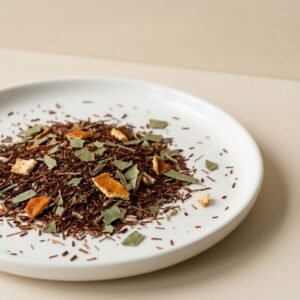
Key ingredients: Eucalyptus + South African Rooibos
Why it works: Eucalyptus has natural soothing properties that support respiratory relaxation, while Rooibos is rich in antioxidants and naturally caffeine-free. Research on Rooibos published in Journal of Ethnopharmacology suggests it may help reduce cortisol and support stress management.
Best for: Evening wind-down, pre-sleep anxiety, letting go of the day
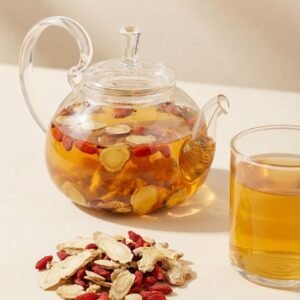
Key ingredients: Ginseng + Ginger + Goji Berries
Why it works: This trio is rooted in centuries of traditional Chinese wellness. Ginseng supports adrenal health and stress resilience, ginger promotes circulation and warmth, and goji berries provide antioxidant nourishment. Studies on ginseng in Journal of Ginseng Research show it may help modulate the stress response.
Best for: Stress-related fatigue, feeling run-down, mid-day wellness breaks
Key ingredients: Inspired by ancient Chinese imperial recipes
Why it works: Post-meal anxiety is real — digestive discomfort can trigger physical symptoms that mimic or worsen anxiety. This digestif blend supports post-meal comfort and inner balance, helping you feel settled rather than stirred up.
Best for: After meals, post-dinner restlessness, gentle evening calm
The CozySlip approach: We design every blend around how you want to feel — not just what you want to taste. From L-theanine-rich green teas for calm energy to caffeine-free evening blends for pure relaxation. Because different people, different moments, need different solutions.
The key to enjoying tea without anxiety is understanding your personal threshold. Here’s a practical approach:
- Drink one cup of your usual tea
- Note any anxiety symptoms on a 1-10 scale
- Record time, tea type, and circumstances
- Switch to white tea or low-caffeine green tea
- Repeat monitoring process
- Compare symptoms
- Replace with herbal tea for one week
- Observe whether symptoms resolve
- This identifies whether caffeine is the trigger
- Gradually reintroduce low-caffeine tea
- Find your personal threshold
This methodical approach reveals whether tea-related anxiety is due to caffeine, L-theanine sensitivity, or other factors.
Some people worry: If L-theanine promotes calm, could it worsen anxiety by creating dependence or tolerance?
Evidence suggests no:
- L-theanine is not habit-forming
- No tolerance has been documented
- L-theanine doesn’t cause dependence or withdrawal
- Natural sources (tea) provide very low doses compared to supplements
L-theanine from tea is safe for daily consumption by most adults.
Reality: Tea’s caffeine can cause anxiety in sensitive individuals. The L-theanine buffer is real but not absolute.
Reality: True herbal teas (not from Camellia sinensis) contain no caffeine. However, some herbal blends are marketed as “tea” while containing actual tea leaves. Always check ingredients.
Reality: Decaffeinated tea may still contain 2-5mg of caffeine per cup. If you’re extremely sensitive, this matters.
Reality: Generally yes, due to lower caffeine and higher L-theanine. But individual responses vary.
Reality: At high doses, caffeine accumulates and can overwhelm L-theanine’s buffering effects. More isn’t always better.
Consider reduced tea consumption or caffeine-free alternatives if you:
- Have diagnosed anxiety disorder or panic disorder
- Are taking benzodiazepines or other anxiety medications
- Are pregnant (caffeine sensitivity increases)
- Experience heart palpitations with caffeine
- Have a known caffeine sensitivity
- Are taking medications that interact with caffeine
Does tea cause anxiety? Sometimes.
For most people, the L-theanine in tea prevents caffeine-induced anxiety, making moderate tea consumption compatible with calm. But individual factors—genetics, stress levels, existing anxiety, consumption patterns—can transform a calming cup into an anxious trigger.
The solution isn’t necessarily avoiding tea entirely. It’s understanding your body, choosing appropriate tea types, and consuming mindfully.
And when tea isn’t the answer? Caffeine-free herbal alternatives offer genuine anxiety support with a centuries-long track record.
Caffeine can worsen anxiety symptoms in those with anxiety disorders. However, tea’s L-theanine may provide some buffering. Consult your healthcare provider for personalized advice.
Some tolerance to caffeine develops over time, but it varies significantly by individual. Some people never develop tolerance and remain sensitive.
Individual caffeine sensitivity varies dramatically based on genetics, metabolism, anxiety history, and current stress levels. Your experience is personal.
This depends on your individual sensitivity. Many people with mild-to-moderate anxiety tolerate and even benefit from tea’s L-theanine. Those with diagnosed anxiety disorders should consult healthcare providers.
Yes. Caffeine-free herbal blends like
Eucalyptus Rooibos (for evening calm) and Ginseng Ginger Goji (for stress resilience) offer anxiety support without any stimulants. They’re worth exploring if caffeine is a concern.
Early to mid-morning, with food, during low-stress periods. Avoid tea on an empty stomach or during already-stressful times.
- Bruce, M.S., & Lader, M. (1989). “Caffeine and anxiety.” Neuropsychobiology.
- Snel, J., & Lorist, M.M. (2011). “Effects of caffeine on sleep and cognitive function.” Nutrients.
- Hindmarch, I., et al. (2000). “The effects of L-theanine, caffeine and their combination.” Psychopharmacology.
4.ampakopoulos, D., et al. (2016). “Chamomile and anxiety.” Phytomedicine.
- Woelk, H., & Arnoldt, K.H. (2007). “Lavender and anxiety.” Phytomedicine.
Last updated: May 9, 2026 | Author: CozySlip Content Team