

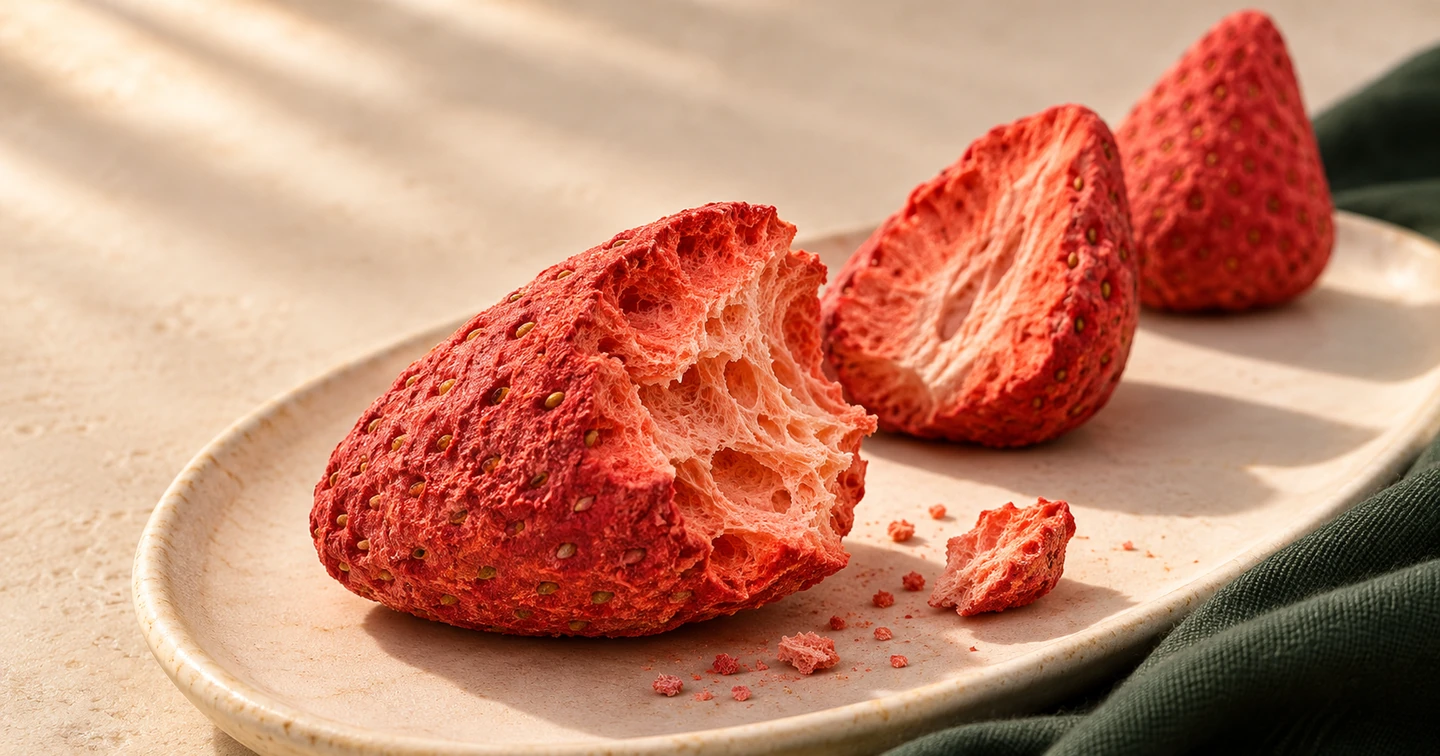
Freeze-dried strawberries can retain much of the vitamin C and polyphenols measured in the starting fruit, but the result depends on the study. Strawberry is a useful showcase for freeze-drying because the supplied research includes comparisons with fresh fruit and other drying methods. Those measurements describe fruit solids, not the nutrients in a cup of strawberry fruit tea.
How Much Did Freeze-Dried Strawberries Retain Compared With Fresh?
In Wojdyło and colleagues’ Kent-cultivar strawberry experiment, as tabulated in the Basu strawberry review used by our research report, freeze-dried fruit retained approximately 98% of the measured vitamin C and 95% of total polyphenols relative to the fresh strawberries on a dry-weight basis. These are calculated ratios from that experiment’s fresh and freeze-dried values, measured after processing. They are not specifications for commercial strawberry ingredients. Read the Wojdyło strawberry drying study. A dry-weight comparison removes water content from the denominator. That matters because comparing the same weight of fresh and dried strawberries otherwise compares very different amounts of fruit material. A larger concentration in dried fruit does not mean drying produced additional vitamin C. The Kent result is a clear example of substantial retention, not a universal target. Another strawberry experiment produced a different pattern, while still favoring freeze-drying over its convective comparator.
What Does the Strongest Direct Drying Comparison Show?
Sadowska and colleagues compared strawberry powders from the same fruit lot. Their study measured vitamin C and a sum of polyphenols, giving a useful paired comparison. The table summarizes the approximate fresh-baseline retention ratios reported in our evidence review. All rows refer to strawberry powders compared on a dry-matter basis. Read the Sadowska strawberry powder study.
| Study method | Vitamin C retained | Measured polyphenols retained |
|---|---|---|
| Freeze-drying: shelf at 21 °C, pressure 10 Pa, duration 48 hours | Approximately 86% | Approximately 82% |
| Convective drying: air at 70 °C, duration 25 hours | Approximately 19% | Approximately 16% |
Every figure in this table belongs to that strawberry powder experiment and its stated conditions. It does not establish what would happen with strawberry slices dried gently at a lower temperature, or with Cozyslip’s supplier process. The supplied low-temperature report found no accessible nutrient-retention dataset for strawberry slices hot-air dried around its target low-temperature range. The Kent and Sadowska results should not be averaged into a brand claim. Cultivar, sample preparation, drying cycle and laboratory measurement can change the outcome. “Polyphenols” also describes a group: a measured sum of identified compounds and a total-polyphenol assay are not interchangeable. Nemzer and colleagues likewise found freeze-dried strawberry performed better than hot-air-dried strawberry for the reported vitamin C comparison. Our evidence report could not extract an exact fresh-baseline percentage from that paper, so none is supplied here. See the Nemzer drying-method comparison.
Why Is Strawberry a Useful Freeze-Drying Showcase?
Freeze-drying removes ice from frozen material as water vapor under reduced pressure. It can limit the prolonged warm, oxygen-exposed conditions involved in some air-drying processes. Its porous structure is also relevant to the dry fruit’s texture and subsequent rehydration. These are general process characteristics, not a description of a particular manufacturer’s cycle. See the freeze-drying process review. Strawberry makes the science easier to examine because the reports include several experiments measuring the same broad compound groups under different drying methods. That supports a focused explanation of preservation, while the differences between results show why the process name alone cannot predict a nutrient percentage. For the broader method comparison, see freeze-dried vs dehydrated fruit. For the measurement principles behind vitamin C retention, see Does freeze-drying preserve vitamin C?.
What Happens to Freeze-Dried Strawberries During Storage?
Drying does not stop every chemical change. In the berry-storage study by Michalczyk and colleagues, which included strawberry, freeze-dried berries generally preserved the measured polyphenol-related properties better than air-dried berries during storage. The supplied report gives a qualitative conclusion, not a strawberry-specific retention percentage or a guaranteed storage window. Read the berry drying and storage study. Keep the fruit protected from moisture, heat, light and unnecessary air exposure, and follow its package directions. The fact that a dried piece still looks recognizable does not establish its current vitamin C content. For everyday handling, use our fruit tea storage guide.
How Do Freeze-Dried Strawberry Pieces Behave in an Infusion?
A porous dried piece can take up water and soften as it rehydrates. That helps explain why its dry texture will change in a drink; it does not mean the piece dissolves completely or that all measured compounds move into the liquid. This is a general expectation from freeze-dried structure, not a timed Cozyslip brewing observation. See the process review on structure and rehydration. The supplied reports contain no direct strawberry study measuring vitamin C or polyphenol transfer into a strained fruit infusion. We therefore do not turn the dried-fruit retention results into nutrient amounts for tea. Our planned guide to what ends up in your cup addresses that separate question. For a Cozyslip serving, follow the current package directions for the complete blend. Each serving includes rock sugar in a separate sachet. Open the plastic serving packaging and transfer the contents as directed; the pouch is not a steeping bag. Where the package permits refrigerated preparation, our cold-brew fruit tea guide explains the preparation approach. Curious how freeze-dried strawberry tastes in a real blend? It anchors our Strawberry Apple Fruit Tea.