

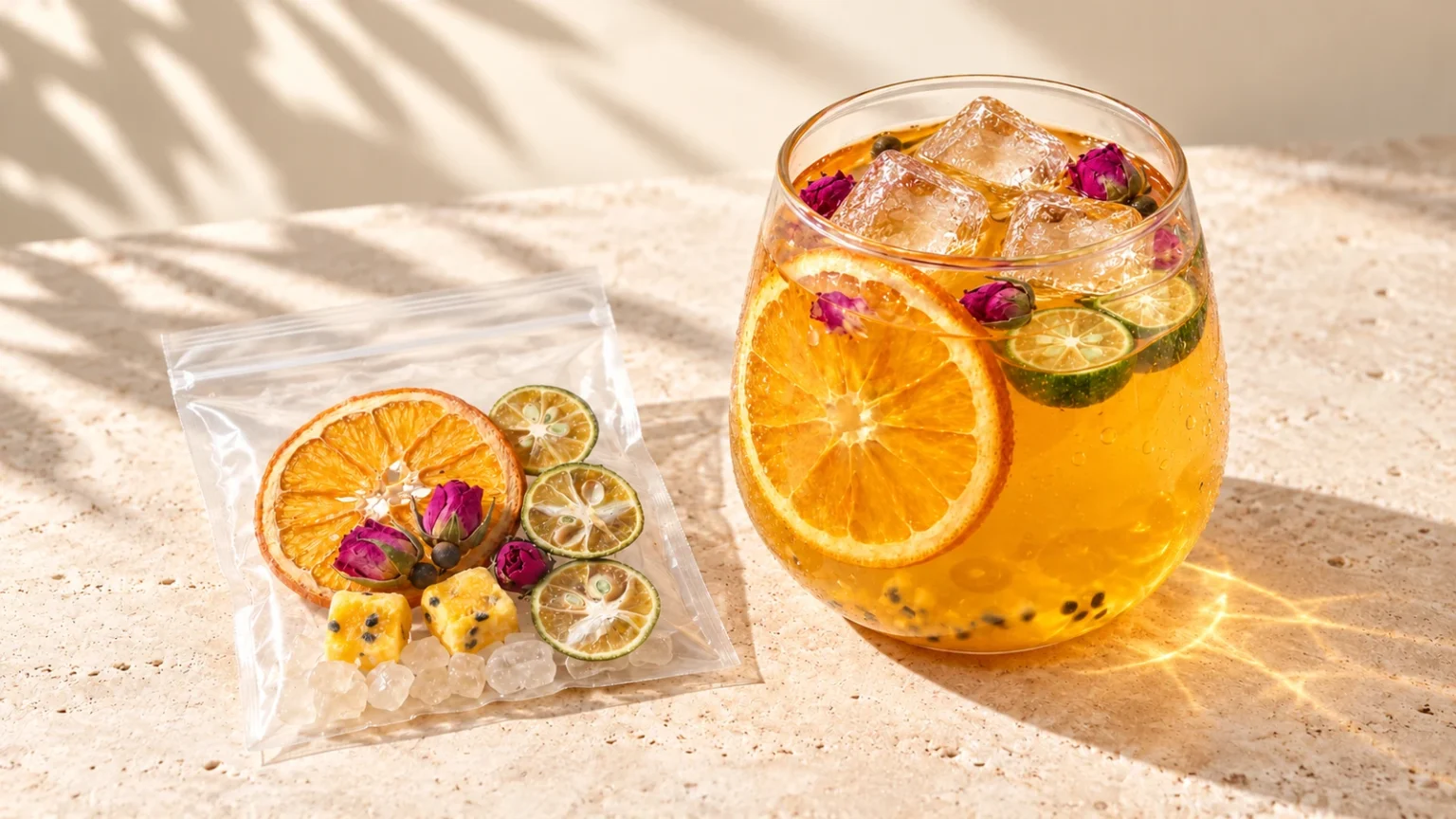
Cold brew tea is made by steeping suitable tea or infusion ingredients in cold water. Start by identifying what you have: loose leaves, dedicated cold-brew tea bags or a prepared fruit-tea serving. Use that product’s quantity, water and timing instructions, and keep a multi-hour infusion covered in the refrigerator.
Key Facts at a Glance
- Cold brew describes a preparation method. Iced tea describes a cold drink and can start with a hot infusion.
- Loose leaves, dedicated cold-brew bags and fruit servings can have very different preparation times.
- Cold water does not turn a caffeinated ingredient into a caffeine-free one.
- Ingredients that require hot preparation should still receive that preparation before cooling.
- One ordinary tea bag and one complete fruit serving are different quantities; match each to its own directions.
First, Identify Your Ingredients
The most useful first step is to check the preparation directions, rather than choosing a steeping time from a different tea.
| What you have | What to check | Your next step |
|---|---|---|
| Loose leaves or ordinary tea bags | Whether the maker provides a cold-brew method, quantity and water amount | Use that method. If only hot-brew directions are provided, prepare as directed and cool for iced tea, or ask the maker about cold preparation. |
| Dedicated cold-brew tea bags | The specific product’s bag count, water conditions and time | Follow its packaging; a few-minute method does not apply to every tea bag. |
| Fruit-tea servings with cold-preparation directions | Complete contents, included sweetener, any separate tea bag and water amount | Open the serving pouch and transfer the brewing ingredients. Keep plastic packaging out of the water. |
| Herbal or fruit mixtures requiring boiling water | The required hot-water temperature and infusion time | Keep the hot-preparation step, then cool the drink if you want it iced. |
Dried ingredients are not necessarily sterile. Germany’s Federal Institute for Risk Assessment, or BfR, recommends boiling-water preparation for ordinary herbal and fruit infusions on hygienic grounds. Check the product’s intended preparation and processing rather than assuming every mixture labeled “herbal” or “fruit” is suitable for cold steeping. BfR’s preparation guidance explains the distinction that matters here.
What You Need to Make Cold Brew Tea
Use a clean, food-safe container with a lid, drinking water, a measuring cup and ingredients suitable for your chosen method. Have a strainer ready for loose ingredients and check that any tea bag is intact. For a multi-hour infusion, make room in the refrigerator before you begin.
Start with a small batch. Note the product, amount of water, starting time and the check time specified in its directions. A single cup makes it easier to learn your preferred strength before preparing a pitcher.
How to Make Cold Brew Tea: Five Practical Steps
- Read the directions. Find the supported preparation method, ingredient quantity and water amount. If the product only provides hot-brew instructions, use those and cool the drink, or ask the maker before cold steeping.
- Measure water and ingredients. Pair the stated water amount with the correct quantity of leaves, bags or complete servings. Do not treat a fruit pouch as the equivalent of an ordinary tea bag.
- Begin the infusion. Use the water conditions specified for that product. Cover a multi-hour cold infusion and refrigerate it from the start. A sunny window or a long counter steep is a different method.
- Check at the stated time. Meet the preparation requirements before assessing flavor. A stronger taste or deeper color cannot establish that hygienic preparation conditions have been met.
- Strain or remove the bag as directed, then serve. Use a clean glass and ice, and return any remaining drink to the refrigerator. If the finished cup is too strong, add a little drinking water and record the adjustment for next time.
How Long Should You Cold Brew Tea?
There is no single cold-brew time for every product. Dedicated quick-infusion bags, ordinary leaves and portioned fruit blends use different materials and preparation systems.
For example, Twinings Peach Cold Brewed describes a five-minute preparation. A Tea and Herbal Association of Canada recipe includes a four-to-ten-hour refrigerated infusion for its leaf-tea example. Those times belong to the respective products and methods; they are not a shared timing range for all teas.
For leaves with a maker-provided cold-brew method, begin with its quantity, water and check time. If cold preparation is not supported by the available directions, use the hot-brew-and-cool route. Keeping a simple note of the exact product, amount, water and time is more useful than copying another blend’s schedule.
Where Cozyslip Fruit-Tea Servings Fit
Current Cozyslip product directions describe one complete fruit-tea serving with 200–300 ml of water, refrigerated for about one hour before stirring gently and tasting. This is the stated starting method for the corresponding servings, not a universal time for loose leaves, tea bags or fruit infusions. Check the current package and individual product page for the blend you choose.
Rose Citrus Bloom, for example, lists orange, calamansi, rose, passion fruit and rock sugar. Open the transparent serving pouch and transfer its brewing contents, including the supplied rock sugar, into your container. Keep the plastic packaging out of the water. Prepare the complete serving first, stir gently as the sugar dissolves, and use your first cup to decide whether to adjust the water next time.
Apple Orange Ember includes a separate black tea bag. Add it according to that blend’s directions. The black tea means the serving contains caffeine; adding fruit or starting with cold water does not change that ingredient fact.
For the detailed serving method, use the one-hour fruit-tea fridge guide. To compare full ingredient lists, explore the current fruit-tea collection.
Is Cold Brew Tea Always Smoother or Lower in Caffeine?
Some teas taste different under particular cold-preparation conditions. Bitterness, aroma and strength also depend on the tea, formula, quantity, water, temperature and contact time.
A 2015 study by Lantano and colleagues compared preparation methods and composition in particular green, black and oolong teas. It provides background on why brewing conditions matter. It does not establish a fixed caffeine or tannin reduction for Cozyslip fruit blends.
If caffeine matters to you, look for black, green, white or oolong tea and other caffeine-containing ingredients, then check the product information. The FDA’s caffeine guidance also notes that sensitivity varies between people. A brewing method cannot promise how an individual will feel.
Use our fruit-tea caffeine guide for the ingredient check. This article does not assign a measured caffeine amount to a serving.
What If Your Cup Is Too Weak, Too Strong or Cloudy?
Too weak
Check whether the ingredient quantity and water amount match the directions, and whether the stated preparation time has been reached. Next time, change one condition within the maker’s guidance, such as the water amount. A longer steep is not a suitable fix for every ingredient. See the fruit-tea weak-flavor guide for more checks.
Too strong or too sweet
After preparation, add a little drinking water to dilute the cup. Record the change so you can adjust within the product directions next time. A formula containing rock sugar still contains a sweetening ingredient when it is cold brewed.
Visible particles or cloudiness
Suspended fruit pieces, cooling changes in a tea-leaf base and storage-related changes need different questions. Neither clarity nor cloudiness establishes whether a drink is safe. Our fruit-tea cloudiness guide explains what to check.
Keep Equipment Clean and Prepare Small Batches
Use drinking water and clean equipment, and keep the container covered and refrigerated. The FDA recommends a refrigerator temperature of 40°F / 4°C or below. That is storage guidance, not a sanitizing treatment for cold-brew ingredients.
Discard a drink with mold-like material, an unusual odor or an uncertain handling history. The absence of those signs does not establish safety either. Do not taste a questionable drink to test it.
Follow the product’s storage directions after preparation. Without a validated product-specific storage period, this guide does not give one multi-day shelf-life promise. Prepare a small amount for your immediate needs and keep it cold. The fruit-tea storage guide covers dry blends and prepared drinks separately.
Frequently Asked Questions
Can you brew any tea in cold water?
Check the product’s intended preparation. Use a maker-supported cold-brew method when one is provided. If the package requires hot preparation, keep that step and cool the drink afterward. Do not assume ordinary herbal or fruit mixtures are suitable for cold steeping just because of their name.
Does cold brew tea have to steep overnight?
No. Dedicated quick-infusion products, ordinary leaves and portioned fruit blends have different directions. Check at the time given for your product; overnight is not a universal requirement.
How much water should I use for one tea bag?
A bag is not a standard dose. Ordinary tea bags, dedicated cold-brew bags and complete fruit servings can contain different amounts and ingredients. Match the bag or serving count to the water amount on its directions.
Can I brew tea hot and add ice instead?
Yes. Follow the product’s hot-brew directions, then cool or serve over ice. That is hot-brewed iced tea. Melting ice dilutes the cup, so use the product’s iced-tea instructions when available.
Does cold brewing make black tea caffeine-free?
No. Black tea contains caffeine. Cold water or a shorter steep does not automatically make it caffeine-free. Check the full ingredient list and product-specific information.
Can I make enough cold brew tea for a week?
This guide does not support one week-long storage promise for all homemade teas. Ingredients, preparation and storage conditions differ. Follow the product guidance, prepare small batches and keep the drink refrigerated.
Start With the Serving in Front of You
Identify the ingredients and preparation method, then measure, time and record. For Cozyslip servings, continue to the fruit-tea cold-brew steps. If your tea only provides hot-preparation instructions, hot-brewed iced tea is another route to a cold drink.
Sources and Product Notes
- BfR: Boiling Water a Must for Herbal Teas — preparation guidance for ordinary herbal and fruit infusions.
- Twinings: Peach Cold Brewed — a specific quick-infusion product example.
- Tea and Herbal Association of Canada: Cold Brew Tea at Home — a separate leaf-tea preparation example.
- Lantano et al., 2015: Effects of Alternative Steeping Methods — the publisher’s abstract on composition under different preparation methods.
- FDA: How Much Caffeine Is Too Much? — variation in individual caffeine sensitivity.
- FDA: Are You Storing Food Safely? — general refrigeration and handling guidance.
This guide explains preparation choices and current product directions. It does not report a Cozyslip brewing comparison, caffeine measurement or shelf-life study.